Members only
A new Homecare Association discussion paper argues for a responsible-capital framework that distinguishes productive, patient investment from financial practices that threaten care quality, workforce conditions, or continuity.
Calls to restrict profit and private investment in social care risk focusing attention on ownership rather than on factors with greater influence on the quality and sustainability of care, according to a new Homecare Association discussion paper.
The paper responds to the renewed debate about profit and private investment in care that has followed the Prime Minister's speech on social care on 29 July 2026, the publication of the Co-operative Party's report, The Power of Co-operation in Care, and early results from the Casey Commission's Big Conversation on Care, in which participants have voted strongly against private equity, offshore ownership and profit.
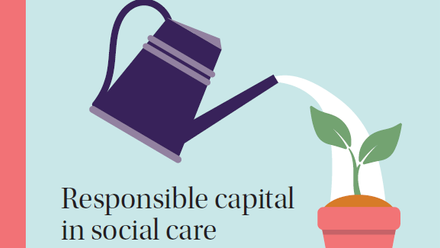
Responsible capital in social care: investment, profit, and policy choices facing the government examines who owns and finances care services, how investors make returns, the relationship between ownership and quality, the sector's future investment needs, and policy options available to government.
Dr Jane Townson OBE, Chief Executive of the Homecare Association, said:
“Making excessive profits from poor care or an underpaid workforce is indefensible. But sustainable organisations need sufficient financial headroom so they can invest, withstand shocks and improve services.
“The important question is not simply who owns a care provider, but how it behaves: is the quality of care good, are workers treated fairly, is the organisation financially resilient, and is money being used responsibly?
“Changing the ownership label does not automatically change leadership, culture, workforce experience or quality of care.”
Social care remains a highly fragmented market dominated by small and medium-sized providers, rather than by private equity. Skills for Care reports that 84 per cent of adult social care organisations have fewer than 50 employees, while 37 per cent have only one to four employees.[i]
Independent industry analyst LaingBuisson estimates that private equity and similar investors, on a broad classification that includes some listed property investors, account for 13.7 per cent of revenue in older people's care homes,[ii] 11.7 per cent of revenue in younger adult specialist care,[iii] and 12.8 per cent of revenue in homecare and supported living.[iv]
The ten largest care home providers hold 18.1 per cent of the market between them, and the ten largest homecare providers 16.4 per cent, with the largest homecare provider holding only 2.7 per cent market share.
The mainstay of investment in homecare remains the equity of owner-operators, often supported by bank lending. Many are locally rooted businesses whose contribution extends beyond care provision to local employment and economic activity. Adult social care in England was estimated to contribute £77.8 billion in gross value added (GVA) to the economy in 2024/25.[v]
Available figures point towards materially higher reported costs for local authority in-house provision and provide no basis for assuming that large-scale in-sourcing would release savings. For 2024-25, the reported full economic cost of local authority residential care for older people was about £1,796 per week, compared with a median council fee of £968 paid to independent homes for state-funded residents.[vi] The external figure is a fee rather than a direct observation of the provider's underlying cost and has to cover the provider's cost of capital and any return. Differences in case mix, occupancy, workforce terms, and wider obligations may also affect the comparison. The data nevertheless demonstrate that the fiscal case for wholesale in-sourcing cannot be based simply on recapturing private profit; the government would need to model acquisition, capital and operating costs on a consistent basis.
Ownership model, by itself, is not a sufficient predictor of the quality of an individual provider. Research identifies associations between some ownership structures and poorer outcomes, but these studies do not establish that ownership itself causes the differences; leadership, culture, workforce conditions, commissioning, funding, governance and the resources available to invest also influence outcomes.[vii]
The paper highlights the continuing need for investment as the population ages. LaingBuisson estimates the value of the United Kingdom's older people's care home estate to be £27.3 billion, while around 43 per cent of existing capacity is not purpose-built.
Dr Townson said:
“If the government wishes to restrict particular forms of private capital, it needs to answer an important question: where will the replacement investment come from?
“Removing an investor does not remove the need for investment. We need capital to modernise services, create capacity, adopt technology and improve productivity.
“Rather than treating all private investment alike, we propose a responsible-capital framework: encourage productive and patient investment, and subject potentially extractive practices to greater transparency, scrutiny and, where necessary, restriction.”
The paper argues that ownership reform should not distract from tackling the structural factors affecting quality and workforce experience.
It builds on the Homecare Association's recent analysis, Homecare: commissioning is the key to quality, fair work and better outcomes, which shows how public commissioning decisions on price, allocation of work, payment mechanisms and assurance shape care quality, continuity, employment conditions and providers' ability to invest.[viii]
Dr Townson said:
“If we want better care and better jobs, we need to focus on the factors that drive them, particularly leadership, culture, governance, funding, commissioning and regulation.
“We should welcome responsible investment in care, whatever its source, and be much tougher on irresponsible behaviour, whatever the ownership label.”
ENDS
For media enquiries, contact: The Homecare Association
Email: [email protected]
Mobile: 07917 853 568
Responsible capital in social care: investment, profit, and policy choices facing the government is a discussion paper by Dr Jane Townson OBE, Chief Executive of the Homecare Association. It examines how social care is financed, how different forms of capital generate returns, the relationship between ownership and quality, the sector's investment needs, and eight policy options available to government.
The paper proposes a responsible-capital framework that distinguishes productive and patient investment from potentially extractive financial practices. It recommends focusing regulation on behaviour and risk - including leverage, transparency, financial resilience and use of resources - rather than treating ownership form alone as a proxy for quality.
Read the full discussion paper: Responsible capital in social care: investment, profit, and policy choices facing the government
The Homecare Association is the UK’s leading membership body for homecare providers, with over 2,100 members nationally, including both for-profit and not-for-profit providers. Its mission is to ensure society values and invests in homecare, so we can all live well at home and flourish in our communities. The Homecare Association acts as a trusted voice, taking a lead in shaping homecare, in collaboration with partners across the care sector. It also provides hands-on support and practical tools for its members. The Homecare Association's members agree to abide by the Association's Code of Practice.
[i] Skills for Care (2025). The state of the adult social care sector and workforce in England.
[ii] LaingBuisson (2026). Care Homes for Older People UK Market Report 36th Edition.
[iii] LaingBuisson (2026). Adult Specialist Care UK Market Report 8th Edition.
[iv] LaingBuisson (2026). Homecare and Supported Living UK Market Report 7th Edition.
[v] Skills for Care (2025). The state of the adult social care sector and workforce in England. Section 1.3: Economic contribution.
[vi] Personal Social Services Research Unit (PSSRU) (2026). Unit Costs of Health and Social Care 2025 Manual.
[vii] Patwardhan, S., Sutton, M. and Morciano, M. (2022). Effects of chain ownership and private equity financing on quality in the English care home sector: retrospective observational study. Age and Ageing, 51(12), afac222.
[viii] Townson, J.K. (2026). Homecare: commissioning is the key to quality, fair work and better outcomes. Homecare Association.