
Amongst the many challenges that domiciliary care agencies face today, having to turn away business is particularly painful. One often quoted reason is when families only want professional reassurance that their family member is OK (they feel care visits are not yet required). Another major cause is even when families need traditional care the agency may not have the capacity for care provision. Both scenarios result in lost customers (Turn-Aways).
Anecdotally, providers are turning away up to half of all enquiries for these reasons. For a mid-sized agency receiving 20 enquiries per week, that could be up to 10 lost opportunities weekly — over 500 annually.
Reassurance services can solve both problems.
What are Reassurance Services?
A reassurance service (RS) provides professional oversight without requiring visits. It consists of non-intrusive sensors in the person’s home to monitor their wellbeing remotely. Door sensors, smart plugs, room temperature, etc, monitor movement, sleep, kitchen activity and home comfort. This data is reported on a single platform where it is reviewed and tracked by a care professional to support user wellbeing. The platform also enables easy communication with the user – most effectively a video call.
Families get peace of mind – reassurance – knowing that a care professional is monitoring routine patterns and wellbeing indicators, while the older adult maintains dignity and autonomy with the confidence that they are being supported unobtrusively.
Real and present need for Reassurance Services
With 30% of over-65s experiencing falls each year [1] — rising to 50% for over-80s — and falls accounting for over 210,000 emergency hospital admissions annually [2], family anxiety is widespread. The challenge for the sector is to meet the needs of the two customer groups; those families’ that need active support, and those that just want reassurance.
Reassurance as a Capacity Bridge
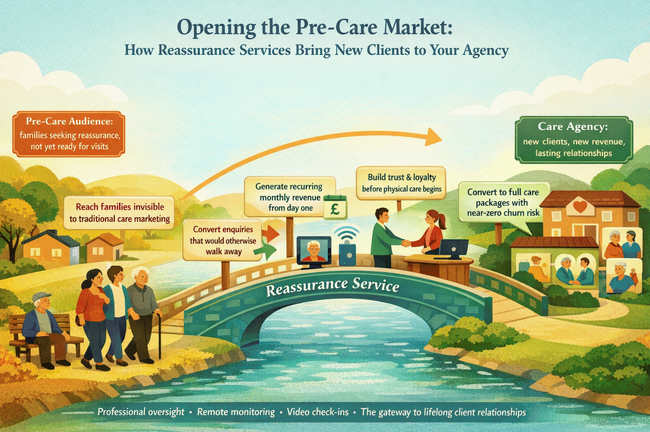
Reassurance services can transform how agencies manage enquiries when care capacity isn't immediately available. Instead of telling families "we'll call you when we have carers available"—which rarely converts—agencies can onboard them immediately into the reassurance service. This keeps customers engaged, generates revenue from day one, and maintains the relationship until care capacity becomes available.
This capacity bridging function delivers immediate support to the family rather than them just being placed on passive waiting lists, and the agency secures the customer relationship. The service brings the agency the opportunity to maintain active engagement (via regular video check-ins, wellness monitoring, and coordinator contact) versus intermittent "are you still interested?" calls.
Addressing the “Pre-care” / prevention demand
Beyond capacity bridging, a reassurance service enables access to the prevention market, where families genuinely aren't ready for traditional care but are looking for professional oversight for their loved one. Older adults value independence and resist regular home visits while families seek professional oversight. These enquiries require a different service entirely, representing additional revenue that no amount of care capacity would capture.
Since these “prevention” relationships are established early, customers starting on reassurance services have a very high likelihood of converting to traditional care with the same agency that delivers the service.
Competitive Positioning
When competitors tell families "we can't help you now" or "call back in a few months," your agency responds "we can support you immediately with our reassurance service, and transition you to full care when you need it and we have capacity." This ability to say "yes" to enquiries, regardless of immediate care worker availability, becomes a significant differentiator.
Local authority commissioners value providers who can accept referrals immediately rather than maintaining long waiting lists. GP practices and hospital discharge teams need partners who can provide immediate oversight even when traditional care capacity isn't available. Early adopters report competitive advantages in winning contracts, receiving priority referrals, and attracting higher self-funder enquiry volumes.
Operational Requirements
Delivering reassurance requires evolution, not disruption. Designate 1-2 experienced coordinators to manage the caseload—senior staff who understand risk and escalation. Define clear protocols: when does reduced kitchen activity warrant a check-in? What movement patterns trigger concern? How do you transition customers from reassurance to care when capacity becomes available?
Since these services are well-aligned with the current ways of working, preparation for their launch should be efficient, making launch possible within a matter of weeks and a an initial investment to cover people, technology, training, and marketing.
Positioning Reassurance Services
Reassurance Services must be positioned clearly as professional oversight and monitoring, distinct from traditional care. Marketing materials should explicitly address both use cases: "Professional oversight while you wait for care to start" and "Peace of mind when care visits aren't needed yet." This clarity helps enquiry handlers convert both types of opportunities effectively.
Technology Enablers
Leading platforms combine passive environmental sensors with video check-in capabilities and coordinator dashboards. Discrete sensors monitor movement patterns, room usage, sleep routines, and kitchen activity without requiring wearables. Dashboards highlight meaningful pattern changes—reduced mobility, altered sleep, decreased kitchen use—enabling early intervention.
Providers of remote monitoring systems include Canary Care, Howz, and Appello. Most platforms provide white-label options, and API integration with care management systems. TV-based solutions offer particular advantages because the television is the most utilized technology among older adults and requires no new device adoption. HomeSight (available through Advanced Technology Solutions, ATS, www.atsolutions.uk) connects through the client's existing TV to provide secure video calling with care coordinators, family and friends. The platform integrates Wi-Fi radar and environmental sensors for multi-modal monitoring of daily living activities, on-screen reminders for medication and wellness routines, and optional connection to wireless health devices.
Why This Matters Now
The domiciliary care market faces persistent workforce shortages that aren't resolving quickly. Agencies that can only accept enquiries when they have immediate care capacity will continue losing customers. Reassurance services provide a practical solution: maintain customer relationships and generate revenue during capacity constraints while positioning for conversion when capacity becomes available.
Combined with the substantial prevention market of families not yet ready for traditional care, reassurance services address two distinct commercial opportunities with a single operational model.
So, the question isn't whether to offer reassurance services—it's whether you can afford to keep telling enquiries "no" when competitors are finding ways to say "yes."
Blog provided by Advanced Technology Solutions, ATS.
References with Available Sources:
1. Falls Statistics - 30% of over-65s, 50% of over-80s
- Source: World Guidelines for Falls Prevention and Management for Older Adults: A Global Initiative, British Geriatrics Society
- URL Landmark publication of World Falls Guidelines | British Geriatrics Society
2. Hospital Admissions - 210,000 emergency admissions annually
- Source: NICE News Article (2024)
- URL: https://www.nice.org.uk/news/articles/new-guideline-will-help-cut-falls-and-related-hospital-admissions-for-older-and-at-risk-people
- Specific data: "In 2022/23 there were around 210,000 emergency hospital admissions in England related to falls for people aged 65 and over"